Monday, March 27, 2006

How to Avoid Search Engine Optimization Scams

Search Engine Optimization scams are nothing new. I've been watching seo companies offering all kinds of questionable programs since I started working in seo in the late nineties.

The troubling part is I see them getting worse before they get better. The seo industry is growing faster each year; 125% in 2005 and predicted to grow 150% more in 2006 according to SEMPO, a search engine optimisation industry organization. With professional seo companies charging anywhere from $2000 and 30,000 per month, the stakes are higher now than they were a few years ago, so the competition is getting fiercer.

We gained a customer last year who came to us to fix their broken seo program after they hired a company they met via e-mail. Their rankings had improved but the only pages that showed up in the search results were very ugly, spammy doorway pages that no-one would ever click on.

The first rule of thumb? Don't buy search engine optimization that is promoted to you via unsolicited email. You want to get to know a company that is going to be intimately involved in the your sites evolution.

Rule number two - get references. This can help identify companies that are more interested in cheap customer acquisition than providing value.

I have been recently been cold-called by a few ambitious seo companies looking for my business. You would think they would do a little more research so as to avoid calling my Toronto search engine optimization company trying to sell search engine optimisation! If you have ended up becoming interested in seo services after a call like this - do yourself a favour and get three quotes. And not only for price comparison but for more important service comparison. Seo is expertise, it's not a commodity.

Rule Number three - get educated on the issues of search engine optimization. When evaluating seo companies for your site, ask and take the time to listen to their proposed plan for your project and compare.

Simply put, seo requires about three or four general areas of knowledge and activity (depending on how you divide it). Unless your potential seo company has a good plan for each of the areas, your solution likely won't provide much benefit.

This is what needs attention on your site:

  • The content. The quality, quantity, depth and freshness are essential. One of the reasons why the good seo companies charge so much per month is because they need to work with you on the planning, creation and optimization of new content. You should be prepared to work with your seo on this, and they should be recommending quality, desirable content for your audience.
  • The code. This is also all of the technical stuff you don't see such as the alternate picture tags, the page titles, the coding of the important elements such as headlines and subheadlines, the page names, the javascript, the stylesheets and more.
  • The architecture. This includes where pages are located, how they are linked, which pages link to each other and what those links say.
  • Your site popularity. The above three are only as important as your sites linkage within the web of other related sites on the Internet. If few other related sites link to yours, your site cannot be very important and will be treated as such in the search results. Visit our site for more information on increasing link popularity.
Anatomy of an SEO scam
One of my top reads these days is the blog by Black Hat SEO. I believe that as an seo expert you need to be at least up to date on the techniques in the black arts so you know what you are up against. He recently published a supposedly funny , but actually quite scary article on how to make $200k per year as a search engine optimization scammer.

The future of the search engine optimization industry:
Now contrast this with a fabulous article written by one of the best SEO's in the business, Bruce Clay. In the emperors new clothes, Bruce lays out his vision of the future of search engine optimization. He covers the main challenges and what it takes to rise to the challenge for the honest and professional SEO practitioner:

Google's take on the SEO industry:
Google has published a page of tips on how to distinguish between good and bad search engine optimization companies.

Information on my Toronto Search Engine Optimization Company:
Toronto Search Engine Optimization Company

Friday, March 10, 2006

Blogs Helping to Achieve High Search Engine Positions

Blogging has taken the Internet by Storm. Not only do they provide an easy method of keeping your audience up to date with your news, help develop stronger relationships with your readers and raise your profile as an expert - they are incredibly effective at helping you increase your web site's ranking in the search engines.

Search engines are giving a large value to blogs. Why? Search engine's common goal is to provide users with the most relevant search results. Relevant content typically equals recent content. Therefore the most relevant results to searches are usually provided on recently updated pages.

Search engines love fresh content, but most of the content on the Internet is quite stale. Blogs, on the other hand, provide loads of recently updated content for the search engines to spider. In contrast, many corporate web sites have not been updated for months or even years.

Search engines also love sites with lots of inbound links.
Many inbound links (links pointing to a site) give the search engines an indication that the site the links point to must be popular or important, and therefore valuable and relevant.

In the blogoshpere it is quite easy to generate a lot of inbound links very quickly. Bloggers and blog readers like to comment on other blogs (which link back to writer) as well as link to other blogs in the main copy and sidebars. If your blog has good content and you actively market yourself in the blogoshpere you will increase your inbound links very quickly. (More on marketing your blog in an upcoming post)

To rank well for almost any phrase in a search engine, you need search optimized content. This is as basic as including the keyword phrases you want to rank for in the content you post to your blog. I'll use my site as an example:

I would like my Toronto Internet marketing company to rank number one in Google for the phrase "Toronto Internet marketing company". If I use the phrase "Toronto Internet marketing company" in my blogposts frequently, the search engine spiders will see this and conclude that my blog must be about a "Toronto Internet marketing company".

Ok this is fine, you may be thinking, I see how I can use keywords in my blog to optimize them for search engines - but how does this help my web site?

In many ways. The first comes back to linking:

The context and content of links are another way search engines determine the content and relevancy of the pages they link to. Search engines are using the anchor text in a link (the text that is actually linked) and the context of the link as a method of determining what the page it links to is about. It's called latent Semantic indexing.

The search engines basically figure that what one site says about another site is a better gauge of truth than what one site says about itself. Compound this times lots of inbound links saying the same things, and the importance of the sites that are saying those things, the search engines have a very good way to measure the relevance of a page for any search.

You need to link to your web site and optimize those links. Since the search engines will read the text that is linked to your web site, they will use those links as a guide to what your web site is about.

I'll use my site as an example again. I have 3 main sections on my web site:

By creatively working these links into my copy, using the correct link text, and linking to the appropriate sections of my site, I am telling the search engines - and my readers - what my site is about. As I get more links and more readers to my blog, I also get the added benefit of more awareness and visitors to my site.

The second benefit is through RSS feeds. You can easily display the live feed of your blog right on your web site, therefore:
  • automatically updating your web site each time you post to your blog
  • increasing the keyword optimization on your web site
  • increasing the content on your web site
Other sites may also choose to display your blog's feed on their site (with each story linking back to you), creating even more links, more readers and more visitors to your blog and site.

Another way you can make the links to your blog help your sites search rankings is to host your blog on your own site. This is easy to do with most blogging software like Blogger, because you can have it simply FTP the blog to your site everytime you post.

Your blog can either be in a subfolder (yoursite.com/blog) or a subdomain (blog.yoursite.com). When you host the blog on your own site - all of the links to your blog are also considered links to your site.

In Summary: Blogs, written well and marketed well, provide all three of the components of a high ranking site - fresh content, optimized content, and lots of semantically relevant, important links.

Friday, March 03, 2006

Separating Qualified Leads from Tire Kickers

B2B companies that sell expensive, enterprise solutions seem to have a common problem: They receive a lot of inquiries from their web site, but many are not qualified prospects.

Depending on the industry and solution they provide, they may receive inquires from small businesses or even the general public looking for solutions that the company may seem to have a possible answer for, but for the company, the economies just don't work for these types of customers.

One large company I work with recently came to me with this issue.

They were looking over the ways they have been addressing the inquiries coming in.
Sometimes leads are assigned immediately to the sales reps and other times they try to fulfill these contacts’ need for information first (with administrative personnel), and then forward to the sales reps.

They wanted other ideas to handle their web inquiries – they wanted to spend less time responding to FAQs and concentrate more on those inquiries that are of direct business consequence.

There are many ways to deal with this issue, but most companies never give it the full attention that it deserves. Here are my suggestions:

Send an automatic FAQ email. Send a self service email designed to answer the most frequently asked questions in inquiries. You can phrase it so that you don't have to personally answer each email, but still provide a timely, relevant, professional response.

For example, tell people that you get a lot of responses, and to serve inquiries better you've put together this list of frequently asked questions that address most of the inquiries you receive. You will read their email, but if their answer is contained in the message they are reading, you won't be getting back to them. After all, they already have the answer. Tell them if they have any other questions, they should contact you again.

Create inquiry forms on your web site that send out custom messages with dynamically generated content for additional personalization. A form can ask many types of questions to give you insight into the nature of the inquiry.

Create auto response messages that include different links and different content depending on the prospects answers from the form. If prospects answer a certain way to a certain question, or series of questions, have that lead forwarded directly to a sales rep.

Follow up more than once. Create messages that go out in a timed sequence after the initial inquiry. Follow up in 2 days to ask if they have the information they need, or if they need any more. Ask if they found the brochure or case study they downloaded helpful. Ask if they would like to speak with a sales rep.

Follow up again after two weeks or a month, with an announcement or information on a recent project or new case study. Follow up again after two months. Start sending your entire email audience a monthly newsletter with information on your industry, your company, and recent developments.

Ask them to qualify themselves. In the follow up emails, ask them for more information. To do this effectively, you'll need to provide them with an incentive to take action. Have a new whitepaper, a demonstration, a sample, a free book, free tickers, a chance to win, something that would interest your audience enough to take a minute and answer a few question for you.

Ask the BANT (Budget, Authority, Needs, Timing) questions so you will see which prospects are 'hot', and respond appropriately.

Use Email polls and links that trigger other actions. With professional Email marketing software, you can trigger other email sequences based on which link a prospect clicks in an email.

For example, you can ask people if they currently use a product like yours or if they are considering it for the first time. Each answer has it's own link that goes to it's own landing page. Depending on which links the prospect clicks, you can send follow up emails that discuss your product in a different way. For the people that already use a similar product, you can provide feature comparisons. For those that are considering the product for the first time, you will want to focus on the benefits your product provides in a different way.

Use engagement devices on your web site to draw even more people in, and ask them to qualify themselves as part of the process. Create an interactive questionnaire on your site that promises to provide an answer to their problem. Ask a series of questions about their need, one after the other, in a small pop-up or embedded Flash or Java element on your site.

Ask questions that flag them as a prospect, a hot prospect, or an unqualified person or company. The end of the process give the answer you promised, and let them know if they should be talking with you or not. Follow up with an email campaign as discussed above, and have the good leads forwarded automatically to your sales reps.

Create more customer self service content on your site. Certainly 90% of the questions that come your way are similar questions asked over and over. Commit to a large, user friendly FAQ or knowledge base section on your site. Consider a forum. Use tag-based web analytics to monitor usage of the section and see how you can improve it. Add to it regularly. Review your search logs to see what the most common searches are, and increase the visibility of content you have, or add more content to address needs.

In Summary:

Focus on intelligent automation of customer self service instead of more efficient manual response to customer inquiries.
Time and money invested in this will pay for itself quickly in costs saved, improved customer relations, and new sales.

Wednesday, March 01, 2006

B2B Lead Qualification Strategy

Lately we've been asked to many business-to-business lead qualification strategies for our B2B clients. It seems now that we have search optimized their sites and put persuasive copy and compelling offers to download information from their sites, they are realizing that they are getting a lot of leads and they need to follow up with them.

Surprised? No. But this is still a great development. Now they are coming around the full circle of Internet marketing and finally, naturally see and want the next step to automating their sales process.

These are my recommendations for business to business lead qualification:

1. Don't get so caught up in the technology - figure out your strategy first

The technology is secondary and the strategy is primary. When you start planning, you should forget the technology and focus on what you want to accomplish from a sales perspective. Let the technology guys figure out how to do it once you've got the strategy. Of course you need to have an idea of what's possible, but why not assume everything is possible from the outset and then figure out how to do it once you have the perfect strategy. Don't be limited by technology.

2. The theory on creating the strategy is simple:

  1. What do you know about them already?
    They have downloaded something(s)
    Whatever else they told us in the form

  2. What does what they've downloaded tell you about them?

  3. What would you say to them based on what you know to engage them further and deepen the relationship?

  4. What can you offer them in exchange for them giving you some more information?
    Here are some ideas: It could be, a chance to win something or something for free. Something for free could be a whitepaper, a demo, a flash demonstration, a free consultation, a free sample, competitive assessment, benchmarking data, etc.

  5. What sort of information do you want from them?
These are the questions you would probably want to ask in return for giving them something they find valuable:

  1. Was the content useful and would you like something else on this topic?
  2. What is your role in researching or buying our product? (also what's your title)
  3. What is your researching/buying time frame?
  4. Is a budget authorized for this product or service?
  5. How quickly do expect the buying process to be concluded?
  6. Would you like to talk to one of our reps?
(ED NOTE: I must admit that I borrowed the above questions from Manhatten's Marketing Maven, because they were so good I didn't have to rewrite them. Thanks Danny. The articles on the blog great except a few points on how to engage people where I differ)

3. Dynamic Content. Sometimes, people may have downloaded more than one item on the site. Therefore I recommend that you should not send out one message per download because many people will then receive multiple messages. You should instead create one message for every contact, and craft segments of the message that are custom to what they've downloaded. It's like an IF/THEN statement. As each message goes out our server will go through a series of IF/THEN's to craft the message. For example:

Dear {NAME}:

We are following up on your recent download of information on our web site.

[IF they downloaded A, THEN tell them this]

[IF they downloaded B, THEN tell them this]

[IF they downloaded C, THEN tell them this]


As a measure of our thanks, we would like to make a special offer to you....

(your choice of X, Y, or Z) ....
... just click here to receive it**


Thanks,

Your Company


** The link should go to a form where you ask for the new information, and fulfill the offer.

4. Automate the process
In a perfect world, this would have all been done before you started getting leads from the web site so that this campaign would go out automatically to each new lead using triggered e-mail within 48 hours. People will tend to forget quickly what sites they've visited and why. You need to remind them quickly to keep their attention.

But in our imperfect reality, where clients want to see proof that extra traffic will come, and that people will download things before they decide to make a bunch of autoresponders, this the next best thing:

1. You create this campaign and send it out to all of the people that have downloaded something. 2. You take the same campaign, and you implement it as an automatic follow up 24-48 hours after all new visitors sign up on your web site.

What you have accomplished is a single follow up to every lead you've generated so far, and then you send an automated follow up every day, for every new lead, from now till you decide to stop.

Sunday, February 26, 2006

The value of tag based web analytics

What's the difference between the free stats programs offered by most web hosts and professional analytics applications like WebTrends 7.5 professional?

Most people are trained to think of their web stats as nothing more than a way to track unique visitors and page views. For a low traffic site, or one that is no more than a forgotten brochure for the business, the difference is perhaps unimportant. However, for anyone considering their web site as a valuable part of their marketing toolset - the difference is enormous.

Data without reference points is meaningless
Tag based analytics enables the marketer to provide meta data about the information on the web site so that the analytics software can provide relevant and interesting
information on the traffic and usage of the site.

A web server cannot tell one page from another from the eyes of a visitor or marketer. The un-tagged information on a free web stats program will not show if certain kinds of content are more popular than others. It will not show you organic search traffic from paid search, which types of visitors are more valuable, most popular paths through the site, or which groups of pages are more useful than others. To extract this kind of meaningful data about your site the marketer needs to teach the software about the site and its traffic.

Information rich data becomes action-able knowledge
The uses of tag based are as varied as the types of sites it can report on. Lead generating sites, e-commerce sites, advertising supported sites, customer service sites, portals and more can all use tag based analytics to provide business intelligence. It enable marketers to consistently improve their results in iteration after iteration of their web site changes. It enables them to target advertising more effectively. They can improve conversion rates, improve content effectiveness, improve user experience, and more.

Accuracy of Information
Before I move on to give specific examples of the information tag based web analytics can provide I think it is important to discuss an issue of accuracy provided by something called client side tagging versus log based statistics:

All free or low cost statistics programs, (and even higher end analytics software unless configured otherwise) will generate statistical data based on the log files created by the web server.

This has a serious flaw.

Web server log files are the raw data collected by the web server for every hit by a visitor. Every time s request is made on the web server, a hit is recorded as a new line in a text file. This can be a request for a page, an image, a PDF, an included object, or any other file on the web site. Each hit is recorded with a timestamp, and the IP address of the computer requesting it, the browser used, and other various and configurable information.

The statistics program simply reads these log files and organizes the information into human readable reports and graphs. Each unique IP address that shows up in the log file is considered a unique visitor.

The problem is, s unique IP address is not enough information to differentiate one user from another. Five users behind a DSL line in a small office will look like one unique visitor. One hundred users in an medium office may look like one visitor. Tens of thousands of AOL users all over America will look like one user. One user from Herndon, Virginia, in fact - because AOL uses a massive proxy server there so it can cache the most popular content on the intent to deliver it more quickly.

There are other log file methods, such as combining IP address and computer type to differentiate visitors, but the limited ways a standard web server can differentiate between one visitor and another is limited and ineffective. Because of this problem log based statistics should be considered by all to be inaccurate.

To solve this problem tag based analytics software uses a technology called client side tagging to uniquely identify each computer visiting it's website - regardless of whether they are in an environment that would otherwise fool the web server into counting them incorrectly. This "client side tag" is a few lines of JavaScript on each web page being analyzed by the analytics software. Each time one of these pages is requested, the computer requesting it automatically runs a script on the page, and reports back to the analytics server to identify itself as a unique computer.

The result is significantly more accurate statistics (nearly 100%), that typically show a large increase in the number of visitors being counted.

Tagging for content usage
Now that I have explained the accuracy of information issue in the two types of reporting, lets move on to the more exciting benefits of tag based analytics.

Paths and Pages
Starting from the most basic level, page name tagging allows you to provide meaningful names to the pages on the site so that it is easier to tell which pages are being visited.

Without tagging, the only ways to view a page in a report is either by URL (address of the page), which can be long, cryptic or meaningless, or the HTML title - which for un-optimized sites are often all the same, and for search optimized sites are often long and difficult to differentiate.

When you teach the analytics server what the pages mean to you - the results are just easier to read. Home for home, Products for products, etc. When you have hundreds or thousands of pages on a site, especially similar ones, this makes a big difference.

Web analytics software can also measure the order of pages visited by each visitor. It will then calculate the most common paths through the site. For example, an e-commerce sites most popular path may be - home, products, product a, product b, search, exit site.

This kind of information can be enlightening. For example, why don't most visitors go to product c? Why don't they add anything to their shopping cart? If everyone is searching what's wrong with the navigation? Is there something wrong with the search results? You can't test and measure without this kind of information.

Content groups and sub-content groups
On my own site, I have four major categories - email marketing, search engine marketing, web analytics, and reviews. Each category has many pages. Since I have tagged all of the pages in each category as a group, I can look at my online WebTrends reports and see which type of content is more useful or more popular with my visitors. This can be an indication of what the market is most interested in. I can check it against my sales and notice correlations or discrepancies.

To make it more interesting, each major section on my web site is broken down into products, services, and knowledge (frequently ask questions). I have tagged these as well so I can see which sub-sections are most popular.

Pages can also have more than one content group and sub-content group. This allows you to have pages show up in multiple group reports - if product A fits under category A and category B, no problem - just tag it correctly and you will see it in both category reports.

To continue with my example, I have tagged each page on my site to have two groups and sub-groups - in reverse of each other. So now I can look at the sub-sections as major sections to see which major sections have the most popular sub-sections.

Basically, any way you want to group your content can be achieved through a well planned tagging strategy.

Tagging for scenarios and funnels
Tagging for conversion is cool. Let's say you have a membership based site and you want to track how many visitors follow a certain path on your site. For example, you may want to track what percentage come to the home page, click the "learn more" page, click the "sign up" page, and then complete the sign up process. No problem.

In WebTrends, you would tag the series of pages as a scenario. You may choose to call the Scenario "perfect user", or "new signup", etc. You would tag each page as scenario step one, step two, etc., and name each of the steps. The end result is a beautiful graphical report that shows you how many visitors started each step, and what percentage went on to the next step.

Additional, invaluable information in this report is the "leakage" in the steps. Where do visitors go from each step besides where you want them to go? This is the information you need to make improvements on your site that will improve your conversion rates.

Tagging for conversion and sales data
For e-commerce and lead generating sites tags give you the information you need to improve your marketing spend. With tagging you can pull sales data into your WebTrends reports. WebTrends can pick up the items purchased and total sales from your 'thank you' page and display this information in your reports.

For search engine marketing (paid and natural search) you can break down your sales activity by keyword phrase and search engine. You can also see it by e-mail campaign, links form other sites, type of visitor and more.

Geographical reporting
It's one thing to see your visitors broken down by country, but what about province/state, city, area code, company, or designated marketing area? All possible thanks to the built in, up-to-date geo-IP database called GeoTrends. The GeoTrends database knows the location of every IP address in your reports and can therefore provide detailed and accurate visitor location information.

Getting the most from web analytics
A professional analytics program like WebTrends essentially allows you to track whatever data you need and turn it into action-able business intelligence. The functionality for this exists out-of-the-box, however to generate the most interesting reports for your business requires some effort on your part.

The ability to tag information on a web site comes with a responsibility to think through the data on the site and what kinds of reports need to be generated from the data collected.

At Agito, we go through a detailed process on every web site we track to ensure that we have identified all of the information we need and tag all of the pages properly. We go through a mapping process to define all of the desired paths through the site. We consider email campaigns and advertising campaigns and plan landing pages that can be tracked. We build spreadsheets of the web site to list every page and the tags that need to be associated with every page to achieve the desired outcomes.

If you want the most out of your web analytics, make sure you go through a process that will uncover your needs and then teach your software to deliver the results you want. You will be way ahead of those who use only free tools, or even professional tools with only out-of-the-box functionality.

Friday, February 17, 2006

Don't buy into useless search engine submission programs

I can hardly believe that many web design companies are still offering search engine submission programs and calling it 'search engine optimization'.

Let me be clear - submission to search engines is a waste of time and resources. It comes from flawed reasoning that your pages need to be submitted to search engines in order to be found. This is simply not true.

Search engine technology works with spiders that crawl all of the links it can find on the web. The spiders index every page they find. If the spider cannot find your page this is indicative of a larger problem that will not be solved with submission.

Pages that cannot be found are either hidden behind internal site links that cannot be crawled (for reasons like poorly designed Java script coding, complex dynamic URLs or pull down form navigation) or completely hidden from the rest of the web because there is not a single link from another site pointing to the page.

If your pages are not indexed in the search engines, then your site has much bigger problems than submission can solve.

Search engines derive a great deal of information about the content of pages from the sites and pages that link to them. The quantity of inbound links to your pages, the quality of sites and pages that link to them, and the words in and around the links themselves play a major role in the ranking of web sites in the search results. Even if your poorly linked page is in the search engines index because of submitting, it won't have a hope of ranking in the top results without better linking.

With a good linking strategy, your pages will be crawled and indexed by the search engines regularly. With our search marketing dashboard, we monitor the various search engines spider activity on all our clients sites. Typically, we see the spiders on our sites every day.

A note to a possible question that may be in the minds of some - even though search engine submission is useless, you shouldn't confuse this with directory submission. Submitting to directories is an important part of inbound link generation. Search engine spiders often start with crawling the major directories as a jumping off point to find sites and links to crawl.

We recommend submitting to all of the major directories, local directories, and researching industry specific directories related to your industry. It is important also to regularly check the directories to make sure your listing has been accepted and is posted. Many volunteer edited directories, like Dmoz, can take many months to be included.

Monday, February 13, 2006

Search Engine Optimization Now to be a Factor in the YellowPages

Now search engine optimization will affect your yellow pages listings as well:

The Canadian YellowPages are about to launch a new service that will do keyword searches of your web site. Results will be displayed in the YellowPages directory based on the content in your site and in combination with how much you are paying them.

The following information is directly from YellowPages, in response to my evaluation of advertising options for our company:

AGITO INTERNET MARKETING:
How can we show up in searches for "internet marketing" "email marketing", "web analytics", "content management system", "Search engine optimization"? eg: do we get to apply keywords to our ad.

YELLOW PAGES: Interesting that you ask because in the not to distant future (June) we are changing the layout of our site to incorporate keyword searches. Those searches will return results of businesses that mention those keywords (in the text of their ad, but also in their websites when linked from the Yellow Pages site).

The important thing to note here is that the results will be re-ranked based on advertising that the business currently does in order to ensure that if someone is for example a national advertiser that they are in fact appearing ahead of someone who is not (even when keywords are used). This will ensure that the value of those products does not diminish in anyway as a result of this more user-friendly interface.

This bodes well for the search optimization industry. It further legitimizes the field and will help it bring the concept into the forefront of advertisers minds. After all, search engine optimization - done well - is really just the perfect classification of your business, the content on your web site, and the linkage to your site.

If your company relies heavily in YellowPages advertising, you should treat this as a wake up call rethink your online marketing. Search Engine Optimization has now become an important factor in your YellowPages advertising.

The YellowPages are still an important method of advertising your business. While SEO is a powerful tool for bringing in traffic and customers, you also need to promote your business where all of your prospects are looking. Our prospects look in the search engines, in the online yellow pages, in the yellow pages book, or ask friends for referrals. We know that - and promote accordingly.

Thursday, February 09, 2006

iDate 2006 Online Dating Conference

Miami - February 2006

The iDate 2006 Online Dating Conference was an eye-opening look at the current state of online dating. I enjoy staying on top of the highest traffic industries on the Internet because the advances and opportunities for testing are more frequent and interesting than in lower traffic situations like the average corporate site. The knowledge I gain from working in industries such as these are immensely valuable in my work in lead, traffic and sales generation for medium sized companies in every industry.

I was a guest speaker at this conference, speaking about promotion of online dating web sites from the affiliate perspective.

The main theme of the presentation was maximizing conversion on web sites from initial visit to free profile, and then maximizing conversion from free profile to paid subscriber with email. Many of the smaller dating sites have not got this figured out yet, while the bigger ones are taking the perfection of this art and science to a new level.

Insights I shared were effective home page and landing page design, including focusing on giving the visitor what they want (the ability to immediately search members) while getting what the web site owner needs (getting permission to market to the visitor via email). It's surprising how many owners thought this was golden information - but when I looked at some of the sites of the attendees after I got home I could how badly this info was needed.

Corporate customers outside the dating industry should take heed to this concept, too. What is it your visitors really want - and how can you give it to them while enticing them to give you their contact information?

The key, of course, to getting conversions to sale is to get the email. Let me repeat that - get the email, get the email, get the email. Do whatever you have to do to get the email. Give away a free e-book, a free prize, access to something incredibly cool and impossible to resist. Once you have an email address you can (and had better) start a calculated campaign to educate, entice, remind and persuade the prospect to become your customer. It is getting incredibly expensive to get a qualified visitor to your site. It is equally expensive, if not impossible, to get them back if you didn't get permission to start a communication with them. Get the email and then start working to get the sale. Very few visitors will become a customer on their first visit to your site, but many more email contacts will become customers over time. If people get one thing from my Internet marketing talks I hope it is this, because this will help them the most.

My other thoughts in this area included the growing importance of niche sites. Since the industry is now maturing, it has become impossible to create a general dating site to take on the leaders unless you have more money than Microsoft. (And Bill, I wouldn't recommend it to you either). With a niche site, at least, you have a hope of becoming the leader in your category. All the profits tend to go to the leader - so be the leader or find something else you can lead in. Niche sites also convert far better, because you can advertise to niche audiences and speak directly to your prospects while having an offer even the leading generalists can't compete with.

Here's another idea - take a page from the adult industry and offer a free tour on your site. New customers appreciate the hand held walk through of your site, how it works, and what they can expect. Visits to tour pages (from my direct experience) are very high. You can tweak them using what you learn from your web analytics software and achieve high conversions at the end of the tour.

One more idea - be different. Don't be a copy cat. Find something that you can do or offer that is truly different. PerfectMatch has their 'Duet' matching system and an ask the expert column called "Dr. Pepper'. Why aren't other sites offering something special like this? It's perceived value that helps the visitor differentiate you from the other sites that they are considering. I heard Match.com offering a free e-book on how to meet someone special in 90 days.

Hello! What do people really want? Figure it out and give it to them.

On the topic of affiliate programs, I suggested to the bigger ones that they adopt revenue share and maximize pay-outs because the CPA (cost per acquisition) is getting higher as competition gets more intense. Affiliates take all of the risk and cover all of the expenses in their promotion of your sites, so owners should never think that they are paying too much for sales that they would otherwise not have had. Owners must think in terms of lifetime customer value of sales generated by affiliates. Most good affiliates promote many sites and will send the majority of their traffic to the sites that convert the best and payout the highest amounts. In this respect, web site owners (in any online selling environment, not just dating) are competing for the best affiliates just as they are competing for customers.

I had one very interesting comment from the audience when I hesitantly brought up trust and honesty in payment reporting. I say hesitantly because I didn't want to offend all of the honest owners I suspected were in attendance, but obviously I am naive in this area. I like to believe that most people and companies are honest. Perhaps I am wrong about that because one well dressed attendee immediately commented that "all dating affiliate programs are skimming".

So what I occasionally suspected is true? Is this really why they resist putting my tracking gifs on their pages - because then I will have bonafide proof that they are skimming? This is terrible! I knew the temptation to skim must be too great to bear - but I honestly had no idea that it was the rule, not the exception! At least if this one attendee was correct.

It just plain makes sense to treat your affiliates honestly, because (for me anyways) it's all about the conversion. If I can get I higher conversion rate from site A than site B, I'll do more A and less B - it's that simple.

Some owners mentioned that they only focus on their top affiliates, giving them high payouts and the like. This is a mistake as well. I said, what makes you think that only your top affiliates are super affiliates? I, for example have two sites that consider us "super affiliates". Yet I promote dozens of dating sites via various online portals and such. I am sure the other dating sites that I promote think we're lame ducks - but they have no idea of the traffic we are able to send to them! If you only pay your top affiliates well, you will never know how many sleeping super affiliates are lying in your database just waiting to be activated.

Tuesday, February 07, 2006

A Pay per Click Success Story

NationalPayDayExpress.com got so many leads through our pay per click and search engine optimization program that they had to ask us to stop!

I am not kidding. The program was so successful at start that they ad to ask us to turn it down for 2 months because they ran out of money to loan out!

How we did it:
They first came to us to help with Internet marketing to the Canadian market for their online payday loan business. After reviewing their site, we recommended they build out a lot more content based around the words we targeted. We told them that a pay per click campaign would get quick short term results and provide valuable research for a long term search engine optimization strategy. The high natural search rankings from the search engine optimization program would provide a better value over the long term.

We came up with a shortlist of keyword phrases and then queried the multiple search phrase databases we use to expand the list and come up with all of the possible variations. The databases we use contain about 300 million of the last search phrases on the Internet and are an invaluable tool for keyword research. We expanded the list to a large number of alternative phrases and then weeded out the ones that would be searched by ones that would probably not be the target market.

The Pay Per Click Campaign:
We created a pay per click campaign based on 768 keyword phrases. We wrote about 50 ads which are specific to the keyword phrases so they convert better, and made multiple versions that we could run a/b tests on them to optimize for the highest converting copy. We set this up in Google (targeted only to Canada), Yahoo (using geographically targeted phrases) and Kanoodle (targeted only to Canada).

We then instrumented the site with our 3rd party bid automation and conversion tracking software. This allows us to automatically raise and lower bids on all the phrases until we find the sweet spot between traffic and cost.

We worked with the client to determine the desired acquisition cost for loan applications so we could set the bidding rules and targets. Because competition was fierce, we also discussed lifetime customer value, so we could consider setting the acquisition cost targets higher if needed to get the customers in, considering that many would come back over and over again.

We now generate weekly reports on all of the costs and conversions so we can see the ROI for each phrase in each engine.

DayParting:
In our regular review sessions with the client we noticed together that the conversions from loan applications to funded loans was following some patterns on time of day and day of week. After discussing the possible reasons for this we came up with an action plan to turn up the advertising during the highest converting times, and stop it during low converting times. This would not be possible without automation software because it requires changing the bids on the 768 more than 20 times per week.

The results? Less money for higher conversions – essentially we get all of the loans for a fraction of the original cost. Competitors will wonder how we can out-bid them and still make money. It’s because we are only bidding on the highest converting terms during the highest converting times per day – and we don’t waste money on the rest.

Search Engine Optimization
First we created about 20 new pages of content on their web site based around the keyword research we did. We weighted heavily the top performing and highest traffic keywords that we found in the pay per click campaigns. The content and code was optimized, and of course we optimized the architecture and internal linking within the site.

We then instrumented the site with WebTrends 7.5 Professional (web analytics software) so we can track the conversions on the natural search vs. paid search and see what cities and provinces the traffic is coming from. In future this will allow us to work with the site design to find out where visitors are having trouble so we can improve the content and the conversion.

Finally, we set up our search marketing dashboard, so we can see the search rankings for all of the phrases in all of the search engines, monitor page rank, spider activity, and more – so we can fine tune our search engine optimization. We give nationalpaydayexpress online access to all of our tools so they can review our work, see the results, and call and ask lots of questions. (which they do!)

It’s still a little early to tell just how good the results are on the SEO campaign, because the new content has only been online for about 6 weeks. However they have gone from zero top ranks to 91 ranks in the first two pages, 47 on the first page and 12 cherished number one spots across the 17 search engines we are reporting on weekly. Rankings are going up fast, and when the directory links kick in, we should be sitting pretty.

I expect that the search engine optimization will drive more traffic than the pay per click very shortly.

Outcome:
We are restarting the pay per click campaign now that some of the loans are maturing.
It sure is nice to have happy customers!

Friday, January 27, 2006

What - They Don't Want My Pay Per Click Traffic?

I've been promoting dating sites for a few years now. Last year we were doing really well. We made 17,000 profit in January. This year sales are down.

Pay per click marketing campaigns that were profitable at 100% last year (by that I mean for ever dollar we invested we got back two). They are down to -10% this year. Well, there is a lot more competition I suppose. So we had to get more scientific about it. Doing it manually was a drag anyways. So we invested in some agency pay per click management software - an ASP service. It's expensive, but it allows us to set targets for acquisitions of emails so that we can put it almost on autopilot. There is a steep learning curve and a lot of configuration - but hey - autopilot sure beats the hell out of logging in and checking your costs and exporting them into a spreadsheet along side your sales.

Sounds like a plan right?

Well it works just fine for our paying clients - where we have control over their sites. We got so much business for one client that he had to ask us to stop for until March so he could catch up on inventory (but that will be another post).

I think that anyone doing paid search manually will not be able to compete with professional automated marketers any more.

But what about the dating? Well, when you are an affiliate you don't have control over the sites that you are promoting. Therefore you can't put your tracking codes on the landing pages and the thank you pages. Therefore it doesn't work.

Well, you would think that if you are sending $10,000 per month in business to a site - through pay per click alone - that they would make an exception, right? Well in theory yes - but I am still waiting month after month for them to 'implement their solution' to allow all affiliates to post tracking codes on their pages.

What happened? Well I stopped promoting them of course! To hell with them - if they don't want my 10k a month in sales then screw 'em. I can't afford to lose 10% on investment for long. And I don't have time to manually tweak it back up to a profit. We still have our portal sites and our advertising and our regular paying clients and we'll keep going with that for now... but sheesh - it must be nice not to have to be concerned about losing that kind of coin because you just can't get your developers to pump out a simple bit of code to show one tracking image or another based on referrer. Especially when your affiliates are taking all of the risk.

Thursday, January 26, 2006

So Google's Gonna Solve the 302 Redirect

So the big news is big daddy - Googles biggest search engine update in years.
You can test your search engine rankings in the new algorithm with these IP addresses:

66.249.93.104
64.233.179.104

Wednesday, January 25, 2006

Guest Speaker on Affiliate Marketing

Next week I'll be speaking on affiliate marketing at the iDate2006 conference in Miami, Florida.

The audience will be mostly dating web site owners. I expect and hope the discussion of conversion from visitors to emails to sales will be of much interest to those attending. For affiliates, your web sites conversion is of utmost importance.

I'll be reviewing top dating web sites and giving my opinion on what works and what doesn't on dating home pages. Actual stats on conversion numbers will be discussed, and why some do much better than others. Business focus, home page focus, special features, free tours, innovative pricing models, and niche marketing are in the presentation.

I will be pushing the importance of detailed conversion statistics and access to add tracking codes to sponsor web sites so affiliates can use automated pay per click marketing software such as atlas one point or keyword max.

I'll also be presenting ways to promote to your affiliates, get more out of your affiliates and how to communicate with them more effectively. Wish me luck!

Saturday, January 21, 2006

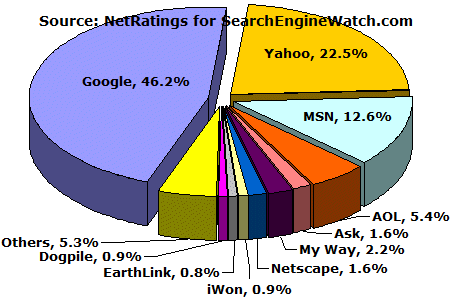
Current Search Engine Market Share

Found this on Search Engine Watch today. It's funny how many clients think that only a Google listing is worth anything. It's true they have the lions share - but do you want some of the customers or all of the customers? Optimizing and measuring for all of the majors is and will remain my choice.

If you only do PPC or SEO on Google than you are missing out on 53.8% of searches. That is missing the lions share in my opinion. Not to mention that in the PPC world bids are just a lot cheaper elsewhere to Google.

Think it's to much work to do PPC on a dozen or so search engines? Well, you are right. It is a ton of work to manage all of the those bids and listings. That's why you should hire professionals that have automated bid management software and the expertise to use it effectively.


Don't bother with automated link programs unless you only care about MSN

We found a way to get to the top of MSN very easily by using a program that gets you about 4000 backlinks measured by MSN within a few months.

The service asks you to post a link directory on your site that they populate - and then you get back links from about 5000 other sites using the same program instantly. It takes about 3 months for all of the backlinks to start appearing in a link popularity test. We found the results are really good in MSN, but Google seems to ignore the links altogether. The sites we used it on got good rankings in MSN but no movement in Google at all.

I am starting to think that it actually hurts the Google ranks because Google is smart enough to know that the majority of the sites are 'non-trustworthy' and therefore your links to them hurt you, and their links to you hurt you.

We are taking it off the sites that we are currently using it on and continuing with the more 'white hat' method of manually searching for and requesting good quality, relevant links. It is definitely a lot slower and more labour intensive, but if Google is what you want (which we do) I can't see any other way at the moment.

Automated Content - The Holy Grail?

We've been experimenting with automated content for some time but have yet to find the perfect solution. Getting to the top of search engines is one thing - but having a site that is interesting and converts is most important when the visitors arrive - and these two goals seems to be frequently at odds with each other.

Recently we've tried articlebot for the task. It's a program that rewrites a page of content using a thesaurus and a common phrases database to rewrite the same content in different language. You can generate hundreds of versions of the same content that is more than 30% unique - so in theory, you can create tons of unique content - and some of it will rank highly.

The results? Well, in some circumstances it works - you never know which pages will rank, but some of them certainly do get good ranks. The problem is the content is generally crap. It reads like it was written by someone that is just learning English and is fumbling for words and uses incorrect phrases and grammar all of the time.

Hardly good content to create trust and keep people reading. We gave up on it after a few attempts.

Automated content has to pass the Touring Test - It has to sound like a real, intelligent human being wrote it.

It seems like we'll stick with caching RSS feeds for now but it is not as good at getting to the top.

Comments are welcome.

v7ndotcom elursrebmem

The latest SEO contest has begun on January 15, 2006. The winner is the person that can have their site rank #1 in Google on May 15, 2006 for the nonsense phrase "v7ndotcom elursrebmem".

These contests are very interesting in the SEO community because a lot can be learned about the Google algorythym by analyzing the techniques, backlinks, etc. used by the winners and the losers of the competition. We'll keep you posted on the results.

The official thread to watch is:
http://www.v7n.com/forums/showthread.php?t=22836

Thursday, January 19, 2006

I say Flash is a bad choice for web site.

I am often told,"but Google can index Flash now". Maybe so. A little bit. But there are more problems than you can imagine.

If you want to read more on this - go here:
http://forums.searchenginewatch.com/showthread.php?threadid=9600

SEO Mike's post says it perfectly:

The problems of indexing and ranking flash for the search engines.
1. Where to start, where is the main content? frame 10 on layer 2??? Your guess is as good as mine.
2. Whats to stop a person from importing text files, xml feeds or database driven content into frames,scenes and layers that are never called or used...
3. How do you write a program that understands heavily actionscripted files that have to be triggered to pull in content...4. Let say we get all the content from all the source files, xml, or database. How do we organize it and break it up like an html site would.and thats just a short list

This is not to mention an even bigger problem with Flash. Users have a general idea of how web pages should work and there are certain conventions of navigation, etc that web sites should follow. The temptation of most Flash designers is to create wacked-out interfaces that are definitely not conventional. Do you think this helps people navigate your site? Do you think people have the time or inclination to figure out your funky navigation?

If you have an art site - fine. If you want to make money with the Internet as a tool - forget it. Use flash in embedded elements. You can make great sites with HTML and Flash together - stick with that.

How crazy can SEO get?

Black hat SEO techniques - not recommended or condoned:
http://www.stuntdubl.com/2005/11/02/unethical-seo/

What is Web 2.0

I am frequently asked what is Web 2.0. Some people that seem to think there is a 'new' Internet coming out that is going to replace the old one. The funny thing is that there is already a new Internet that the current one has almost invisibly morphed into already.

Web 2.0 is not a new technology. It's not a new platform. It's more like a milestone - a turning point that we have crossed at some fuzzy point in the last few years. It's in the way the Internet is being used, the applications that are being developed, the new ways of thinking about what can be done, the new ways of co-laborating, the new connections and layers of connections. At least that's my humble stab at an explanation.

For the most fabulous explanation of what is actually going on - read it from the guy who coined the term, Tim O'Reilly:
http://www.oreillynet.com/pub/a/oreilly/tim/news/2005/09/30/what-is-web-20.html

Monday, January 24, 2005

Death of the Yellow Pages

Last month I wanted to buy a “memory foam” bed topper and I wanted to do some comparison shopping. So I went online. I didn’t search for “memory foam” – I searched for “memory foam Toronto”. I looked through all of the results and I could not find a store in Toronto that carried them – but one place in Quebec kept popping up. After a few more fruitless searches I visited the Quebec site and learned that they offer free shipping and could deliver in two days. So I bought it.

Surely there are plenty of stores in Toronto that carry the product, but I could not find one. Had a Toronto company had invested in search engine marketing my search would have been worth $500 to them. I would have drove there and made the purchase that day.

So it should be no surprise that a recent study by MarketingSherpa.com found that 77% of online purchases originated from a search engine.

It used to be that many businesses could get a steady stream of customers simply by advertising in their local yellow pages. For some it may still be true, but I believe those days are numbered. My Yellow Pages directory went in the blue box the day it was delivered.