Showing posts with label search in the news. Show all posts

Monday, October 20, 2008

So Google can NOW Index Flash? Really....

Every so often I hear that Google can now index flash files, sometimes presented as if it's a great gift to the world, and we can all now finally shed the archaic HTML system and build a beautiful new flashy Internet that we'll all be better off for.

This time it's started again with some big official announcements back in July:

And there's a lot of discussion about it again, mainly around the same topics that have came up before.

So is it real this time?
Yes it’s real, but there is still a big difference between being indexed, and being found on the first page of results.

Even now that Google can now index flash files, it is still is and will always be difficult for Google to understand the hierarchy of information in the flash file, so don’t think flash is going to be at the top of the search results any time soon.

Here are a few examples of the problems with flash, even now that Google can index the content:

  1. What constitutes a page in a flash file? A flash file appears as a single page, and there is no way for Google to externally reference a specific section of the flash. Google likes to send visitors to the most appropriate page that matches their search, and visitors like going to the most relevant content. But you can only send someone to the home page of a flash file. This is not in Google’s interests, the site owners interest, or the visitors interest, so this factor alone makes it very unlikely flash files are going to start competing for top rankings.
  2. Where are the titles, headlines, subheadlines and most important content? Since flash designers aren’t constrained to any of the HTML standards of defining title tags and headline tags, they may all do it differently, making the context and importance of content difficult to determine.
  3. Images: Many flash files make extensive use of images and video. Google is still unable to parse words from images, so if your navigation or content uses images, it will not be indexed.
  4. Meta data: There are standards for defining information about the information in HTML (meta tags, robots.txt files, no-index, no-follow commands, XML sitemaps) that help Google understand the information on a site. None of these exist in flash.
These are a few of the reasons why it will always be difficult to optimize, and get good search engine rankings, with 100% flash websites. Add to this the problem that it’s too easy for Flash designers to make non-standard navigational schemas and therefore make the site difficult to navigate, it still makes no sense to me why anyone would make a 100% flash website (except in cases where the site is intended to provide a unique “experience” and search engine visibility is completely unimportant).

This does not mean that you shouldn’t use flash. A marketer can still take advantage of all the benefits of flash by chopping it into elements that can be included in an HTML layout. It can still even appear as if it was 100% flash. The difference is that the site would be structured in a standard way that can provide context to the content, and the content would remain in a form that can be externally referenced (you can send someone to a specific page). It’s important when building a site like this that an SEO professional is consulted on how the content is built in Flash to maximize visibility.

It turns out I wrote a post about the difficulty of indexing flash and ranking in the search results with a flash site back in 2006. I wonder if I'll write about it again in 2010? My guess is yes.

Thursday, October 16, 2008

Joe the "Plumbers" Win the Google Lottery

Move over Joe Sixpack, meet Joe the Plumber. Joe was mentioned 25 times during last night’s Presidential Debate, primarily by John McCain in a last desperate attempt to get something to stick to Obama. Joe has become an overnight star: The Guardian reports everyone on Facebook wants to be his friend; people are “tweeting” about him like crazy; he’s rocketing to number one on YouTube.

Anybody need a plumber?

It occurred to me to check where Joe is on Google this morning. No surprise, he had already made it to the top on Google Canada, right behind the guy who might just be the luckiest plumber in Canada this morning: Whitby’s Joe the Plumber. In fact, across the world there are more than a few ordinary Joes that might have a right to feel like they’ve won the lottery. I’m talking about Joe Lara (joelaratheplumber.com), Joe from Seattle (joetheplumberseattle.com) and the grand prize winner, Joe from Amarillo – joetheplumber.com. They should probably all invest in larger servers – and hire a few more plumbers. After all, from now on, what’s the key phrase that will come to mind next time anyone needs a plumber?

And while these average Joes may get pushed aside by the Joe the Plumber on Google for a little while, it won’t be long before his 15 minutes of fame is down the drain. Unless he wants to pay a plumber in Amarillo a sink full of cash for joetheplumber.com. The only downside for Amarillo Joe? There goes his tax cut.

Friday, October 03, 2008

Important Google Adwords Changes

It's been two weeks since the implementation of new Quality Score changes at Google. What's been the effects?

(If you don't know, Quality Score is a factor Google uses to determine how much you have to pay to bid for any spot in the sponsored search results for a key phrase. A low quality score will force you to pay more than others for clicks on the same position.)

Quality score is getting more important - and more manageable
Since quality score focuses heavily on click through rate it does put pressure on advertisers to get more in line with Google's interests, but they aren't entirely against advertisers interests either.

Now that Google is showing us a score on a scale of ten versus the old display of a few words like "poor", "good" or "excellent" we can see to a greater degree of accuracy where the relevancy problems may exist and address them.

How do you improve your campaign?
Tightening the focus of campaigns and ad groups, more closely matching ads to keywords, having better landing pages - all of these changes will improve your quality score, and therefore decrease your average cost per click for the same traffic.

Below is my short hand version of the factors that affect the Google Quality Score:

  • Click through rate (based on keyword and your whole account)
  • relevancy of ad text to keywords (in the matched ad and the ad group)
  • quality of your landing page
  • and "other relevancy factors" (no kidding)
The bottom line is we need to keep optimizing
I just heard an interesting tip listening in to the PPC Rockstars podcast with David Svetela interviewing Brad Geddes:

Consider how Display URL is a factor. In display URLs the root of the domain has to match, but everything else is OK to change. This is important to understand. Giving the searcher information about where they are going to land, in the form of the display URL, is going to help.

Tweaks like this will influence click through rate, which of course influences quality score, which in turn helps us pay less for the same traffic. Or more likely - help stop from paying more.

Saturday, August 04, 2007

NY Times Explains the Google Search Engine

If you are not in the Internet marketing industry, and want to get a feel for what exactly is all the fuss about search engine marketing, there is a good article on Google in New York Times last month that I just found, ironically, while searching for references to the Google search quality team: New York Times on Google

Tuesday, February 06, 2007

SEM, Email and SEO # 1, 2 and 3 in Online Marketing

As a wrap up on 2006 marketing, MarketingSherpa and ad:tech created a survey to ask online marketers what worked in 2006 and where they expected to spend their time, efforts and dollars in 2007:


What I find really interesting is that Email is both on the top of the list - and the bottom. House lists rank #2 in effectiveness, while rented lists are on the bottom. Our email marketing business is reflecting that trend, with more and interest being shown every day - in an industry that I was thinking was starting to mature.

Another business I thought was starting to mature was search engine optimization - yet SEO showed the biggest jump this year.

SEM (PPC) slipped slightly, surely due to increased click costs and the increasing fear of click-fraud. I believe staying away from the content network in Google is your biggest hedge against this. All of the recent interest in PPC is most likely what's driving the growing interest in SEO. Now that marketers see that search marketing really works, they want to find new ways of getting that golden targeted traffic from search engines without paying the crazy costs per click.

Overall, It's nice to be validated in that the three main focuses of our company line up perfectly with what works in online marketing. And, yes, that's by design.

Friday, November 03, 2006

Toronto News Release Optimization Success Story

Finally, PR companies are seeing the value in optimizing for the online news search engines:
We just optimized a release for a PR company that is working for a skin care company. This company found us through Google, looking for "Toronto news release optimization". (We are number three if you select 'pages from Canada'... hmmm, I'll have to take another look at that because we can definitely do better there.)

Anyways, this is how it worked:

The first thing we did was research on the 20 or 30 appropriate terms to do wit their press release. Most of the terms are searched less than 10 times per day. One is searched more that 3000 times per day. So we chose the top 3 most searched terms and optimized for those. The release went out yesterday and here are the ranking results so far:

Google.ca News:
"skin care" - position #7
"lip liner" - position #1
"anti-aging" - position #1

Yahoo.com news:
"Skincare" - position #1 and #2
"Lip liner" - position #1 and #2
"Lipstick" - position #4
"Anti-aging" - position #1, #2

I cannot seem to find it in Yahoo Canada yet, which is strange. We'll check again later today. The results overall look very good so far! With the strong search traffic on the terms we chose it should be a huge success. Let's see what the traffic numbers look like in a few days.

If you are sending press releases, I highly recommend news release optimization and submission to Google and Yahoo news. The last release we did for ourselves quadrupled our daily traffic for several days, and we got a few very good leads in the first few days.

Monday, August 28, 2006

AOL Search Data Insights for Local Search

Ken Mccarthy brought up an interesting point about the AOL data that was mistakenly published a few weeks ago. In his blog, attributing this point to Lee Gomes from the Wall Street Journal (published free here), these are the top 10 most searched words in the list:

1. free
2. new
3. lyrics
4. county
5. school
6. city
7. home
8. state
9. pictures
10. music

The fact that county, city and state are some of the top 10 most popular phrases seem to point to an increased number of local searches. This is huge to local search advertisers. Seems like my prediction of the death of the yellow pages (a fairly obvious prediction to me) is coming true (of course).

Another interesting point was the fact that so many searches start with the 5 W's: Who, What, When, Where, Why. It seems that searchers still like to put searches in the form of questions. You would think that AskJeeves would have done better than it did then, but there is still an opportunity here.

Perhaps we should be using more questions on our site linking to answers. FAQ's are an obvious place to do this. Also, working up personas and the questions each would have, and then posting the questions and answers on the appropriate pages would help bring search traffic.

Tuesday, August 08, 2006

Search Engine Spammers Say Big Thank You to AOL

AOL, in an apparently innocent release of search history information to the 'research community' has released 2GB of searches over a recent 3 month period.

They thought they didn't release personally identifiable information because they didn't include user information, however in reality it is possible to identify many AOL users simply by their search history. The files released link each search together by a randomly assigned user ID number.

Since many people do 'ego searches', that is, searching for their own name, address, etc., this alone can identify users. Linked with location searches, hobby searches, etc., many users can be identified by those looking with almost guaranteed accuracy.

What about those searching for pornography, new jobs, dating sites, illegal drugs, and on and on? Over 650,000 users have had their online privacy violated.

Of course AOL apologized, and removed the link to the data quickly, but the damage has been done.

Search Engine spammers will use this information to build massive automated sites on the 'long tail' of searches; optimizing pages for thousands of rarely searched terms that are easily targeted and will each bring a trickle of affiliate sales or adsense revenue.

Others will use the information for honest keyword research. This Internet marketer was lucky enough to grab a copy from a mirror site last night.

Tuesday, May 30, 2006

Google to become even more important for search engine optimization

Google and Dell announced on Thursday that Dell will be pre-installing Google software on their computers.

This is another made another major breakthrough for Google in their fight with Microsoft and Yahoo to own the world's search market. Google has a 43% market share currently, growing for the ninth straight month in a row. With Google partners included, Google provides the search results for more than 50% of the worlds searches each day.

With over 5 billion searches each month, optimizing your web site to get in front of your relevant traffic has never been more important.

Wednesday, April 12, 2006

The White Hat Vs. Black Hat Search Engine Optimization Debate is BS

That's the word from the CAC2006 conference in Amsterdam.

Rasmus Srrensson from Notabene.net, a 25 person search engine optimization firm in Denmark, proclaimed "there is no black hat or white hat search engine optimization. It is all just risk assessment", in his presentation to the audience of affiliates and sponsor companies.

Rasmus suggested you ask yourself: "are willing to have your site dropped? If no, maybe you shouldn't even be trying to rank in search engines... Search engine spamming and black hat SEO techniques are not illegal."

The CAC is the Casino Affiliate Conference. It is held twice annually, once in Las Vegas and once in Amsterdam. Over 600 affiliates and sponsor online gaming companies congregate to share information and make new business deals.

I feel that to be best the field of search engine optimization, one needs to be understand be able to apply the techniques of the best search optimizers in the world. The decision to go to the CAC2006 in Amsterdam was not a mistake.

By far the hottest topic this year is search engine optimization. The companies and affiliates that manage to secure the top positions for the most trafficked phrases are scoring the biggest new customers wins. With the worldwide online gaming market estimated to be somewhere between 15 and 30 billion dollars (USD) annually, the competition for search engine rankings is among the highest in the world.

Search optimization is all grey hat
Clearly, if so called "black hat search engine optimization techniques" are not illegal, then the option is available to all competitors in any industry. The most aggressive will likely use it and probably dominate the search engine results.

Rasmus has a good point. If you are concerned about your search engine rankings, and especially if you are in an already highly competitive online category, you need to be aware of the options available to you and your competitors to compete in the search engines.

Black and white are far too polarized terms to describe search engine optimization techniques. In reality, everything is a shade of grey. Often it's not what you do, but how you do it that makes it lighter or darker in the spectrum.

Take content for example. Increasing site content is an important factor in search engine optimization. The kind of content that you create, or how you create it, makes it black hat or white hat. Pure white hat would be adding relevant articles that you created from company resources. Pure black hat would be creating portals by scraping content off of other sites and mixing it up with other content so as to be unique.

The realist, the grey hat SEO, understands that in order to provide quality content for the user, and compete with the pure black hat optimizers, it must take a more aggressive approach to search engine optimization.

The grey hat SEO asks himself:
Where can I find quality content of interest to my audience?

  • Quality on topic blogs with RSS feeds?
  • News feeds?
  • Press release feeds?
  • Articles from other sites?
  • Partners: customers, suppliers, friends?

How can I create a page, or whole sections of content, targeted specifically at a two, three or four word phrase that I am most interested in?

How can I maximize the use of this content? Can I reuse bits and pieces of different content sources randomly to increase the uniqueness of each page? This is important if you have hundreds or thousands of pages targeting very specific, but similar phrases.

Can I create geographically targeted content? For example, can I build a separate page for each town and city that you sell in (taking care to have unique content on each page), and linking them all up through the site map for the search engines to find?

Should I create a portal for my industry? Can I create enough content to make a valuable industry resource, and then use it as both an advertising vehicle for my own site and a search optimization playground?

Does having a portal - or multiple portals - allow me to better take on the "black hat" seo competition without risking my own site's reputation?

These are just a few of the options for content alone. Then there is the actual optimization and linking strategies to consider. What about blogspam, linkspam, logspam and hijacking? What do you need to know about these activities?

What everyone needs to know:
  • the competitive landscape for your industry
  • the options available and potential rewards of each option
  • and costs and the risks of each option

To know these you will likely need a competent search engine optimization company. Not just a web design firm that knows how to make the meta tags correctly, submit your site to a bunch of search engines and make a monthly report. You need a company that understands the whole search engine optimization landscape.

My company, Agito Internet Marketing, specializes in SEO for small and medium mainstream businesses for the purposes of lead generation and online sales. If you are looking for a Toronto search engine optimization company, please contact me.

Monday, February 13, 2006

Search Engine Optimization Now to be a Factor in the YellowPages

Now search engine optimization will affect your yellow pages listings as well:

The Canadian YellowPages are about to launch a new service that will do keyword searches of your web site. Results will be displayed in the YellowPages directory based on the content in your site and in combination with how much you are paying them.

The following information is directly from YellowPages, in response to my evaluation of advertising options for our company:

AGITO INTERNET MARKETING:
How can we show up in searches for "internet marketing" "email marketing", "web analytics", "content management system", "Search engine optimization"? eg: do we get to apply keywords to our ad.

YELLOW PAGES: Interesting that you ask because in the not to distant future (June) we are changing the layout of our site to incorporate keyword searches. Those searches will return results of businesses that mention those keywords (in the text of their ad, but also in their websites when linked from the Yellow Pages site).

The important thing to note here is that the results will be re-ranked based on advertising that the business currently does in order to ensure that if someone is for example a national advertiser that they are in fact appearing ahead of someone who is not (even when keywords are used). This will ensure that the value of those products does not diminish in anyway as a result of this more user-friendly interface.

This bodes well for the search optimization industry. It further legitimizes the field and will help it bring the concept into the forefront of advertisers minds. After all, search engine optimization - done well - is really just the perfect classification of your business, the content on your web site, and the linkage to your site.

If your company relies heavily in YellowPages advertising, you should treat this as a wake up call rethink your online marketing. Search Engine Optimization has now become an important factor in your YellowPages advertising.

The YellowPages are still an important method of advertising your business. While SEO is a powerful tool for bringing in traffic and customers, you also need to promote your business where all of your prospects are looking. Our prospects look in the search engines, in the online yellow pages, in the yellow pages book, or ask friends for referrals. We know that - and promote accordingly.

Thursday, February 09, 2006

iDate 2006 Online Dating Conference

Miami - February 2006

The iDate 2006 Online Dating Conference was an eye-opening look at the current state of online dating. I enjoy staying on top of the highest traffic industries on the Internet because the advances and opportunities for testing are more frequent and interesting than in lower traffic situations like the average corporate site. The knowledge I gain from working in industries such as these are immensely valuable in my work in lead, traffic and sales generation for medium sized companies in every industry.

I was a guest speaker at this conference, speaking about promotion of online dating web sites from the affiliate perspective.

The main theme of the presentation was maximizing conversion on web sites from initial visit to free profile, and then maximizing conversion from free profile to paid subscriber with email. Many of the smaller dating sites have not got this figured out yet, while the bigger ones are taking the perfection of this art and science to a new level.

Insights I shared were effective home page and landing page design, including focusing on giving the visitor what they want (the ability to immediately search members) while getting what the web site owner needs (getting permission to market to the visitor via email). It's surprising how many owners thought this was golden information - but when I looked at some of the sites of the attendees after I got home I could how badly this info was needed.

Corporate customers outside the dating industry should take heed to this concept, too. What is it your visitors really want - and how can you give it to them while enticing them to give you their contact information?

The key, of course, to getting conversions to sale is to get the email. Let me repeat that - get the email, get the email, get the email. Do whatever you have to do to get the email. Give away a free e-book, a free prize, access to something incredibly cool and impossible to resist. Once you have an email address you can (and had better) start a calculated campaign to educate, entice, remind and persuade the prospect to become your customer. It is getting incredibly expensive to get a qualified visitor to your site. It is equally expensive, if not impossible, to get them back if you didn't get permission to start a communication with them. Get the email and then start working to get the sale. Very few visitors will become a customer on their first visit to your site, but many more email contacts will become customers over time. If people get one thing from my Internet marketing talks I hope it is this, because this will help them the most.

My other thoughts in this area included the growing importance of niche sites. Since the industry is now maturing, it has become impossible to create a general dating site to take on the leaders unless you have more money than Microsoft. (And Bill, I wouldn't recommend it to you either). With a niche site, at least, you have a hope of becoming the leader in your category. All the profits tend to go to the leader - so be the leader or find something else you can lead in. Niche sites also convert far better, because you can advertise to niche audiences and speak directly to your prospects while having an offer even the leading generalists can't compete with.

Here's another idea - take a page from the adult industry and offer a free tour on your site. New customers appreciate the hand held walk through of your site, how it works, and what they can expect. Visits to tour pages (from my direct experience) are very high. You can tweak them using what you learn from your web analytics software and achieve high conversions at the end of the tour.

One more idea - be different. Don't be a copy cat. Find something that you can do or offer that is truly different. PerfectMatch has their 'Duet' matching system and an ask the expert column called "Dr. Pepper'. Why aren't other sites offering something special like this? It's perceived value that helps the visitor differentiate you from the other sites that they are considering. I heard Match.com offering a free e-book on how to meet someone special in 90 days.

Hello! What do people really want? Figure it out and give it to them.

On the topic of affiliate programs, I suggested to the bigger ones that they adopt revenue share and maximize pay-outs because the CPA (cost per acquisition) is getting higher as competition gets more intense. Affiliates take all of the risk and cover all of the expenses in their promotion of your sites, so owners should never think that they are paying too much for sales that they would otherwise not have had. Owners must think in terms of lifetime customer value of sales generated by affiliates. Most good affiliates promote many sites and will send the majority of their traffic to the sites that convert the best and payout the highest amounts. In this respect, web site owners (in any online selling environment, not just dating) are competing for the best affiliates just as they are competing for customers.

I had one very interesting comment from the audience when I hesitantly brought up trust and honesty in payment reporting. I say hesitantly because I didn't want to offend all of the honest owners I suspected were in attendance, but obviously I am naive in this area. I like to believe that most people and companies are honest. Perhaps I am wrong about that because one well dressed attendee immediately commented that "all dating affiliate programs are skimming".

So what I occasionally suspected is true? Is this really why they resist putting my tracking gifs on their pages - because then I will have bonafide proof that they are skimming? This is terrible! I knew the temptation to skim must be too great to bear - but I honestly had no idea that it was the rule, not the exception! At least if this one attendee was correct.

It just plain makes sense to treat your affiliates honestly, because (for me anyways) it's all about the conversion. If I can get I higher conversion rate from site A than site B, I'll do more A and less B - it's that simple.

Some owners mentioned that they only focus on their top affiliates, giving them high payouts and the like. This is a mistake as well. I said, what makes you think that only your top affiliates are super affiliates? I, for example have two sites that consider us "super affiliates". Yet I promote dozens of dating sites via various online portals and such. I am sure the other dating sites that I promote think we're lame ducks - but they have no idea of the traffic we are able to send to them! If you only pay your top affiliates well, you will never know how many sleeping super affiliates are lying in your database just waiting to be activated.

Thursday, January 26, 2006

So Google's Gonna Solve the 302 Redirect

So the big news is big daddy - Googles biggest search engine update in years.
You can test your search engine rankings in the new algorithm with these IP addresses:

66.249.93.104
64.233.179.104

Saturday, January 21, 2006

Current Search Engine Market Share

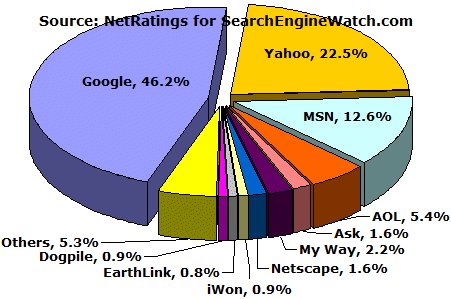
Found this on Search Engine Watch today. It's funny how many clients think that only a Google listing is worth anything. It's true they have the lions share - but do you want some of the customers or all of the customers? Optimizing and measuring for all of the majors is and will remain my choice.

If you only do PPC or SEO on Google than you are missing out on 53.8% of searches. That is missing the lions share in my opinion. Not to mention that in the PPC world bids are just a lot cheaper elsewhere to Google.

Think it's to much work to do PPC on a dozen or so search engines? Well, you are right. It is a ton of work to manage all of the those bids and listings. That's why you should hire professionals that have automated bid management software and the expertise to use it effectively.


v7ndotcom elursrebmem

The latest SEO contest has begun on January 15, 2006. The winner is the person that can have their site rank #1 in Google on May 15, 2006 for the nonsense phrase "v7ndotcom elursrebmem".

These contests are very interesting in the SEO community because a lot can be learned about the Google algorythym by analyzing the techniques, backlinks, etc. used by the winners and the losers of the competition. We'll keep you posted on the results.

The official thread to watch is:
http://www.v7n.com/forums/showthread.php?t=22836